


Look closer. Engineering construction
Design, build and maintain the systems that keep the world running. Your engineering construction career starts here.
Every time you charge your phone, pour a glass of water or grab something to eat skilled people are designing, building and looking after the facilities that make it possible. They work in an industry called engineering construction.
It’s not about building houses, think bigger – nuclear power stations, wind farms, oil and gas refineries and water treatment plants are just a few of the amazing places people in engineering construction work. So whether you’re weighing up your options after your GCSEs, finishing a degree or simply wondering what comes next, look closer to explore the hundreds of careers that power your every day.
There are hundreds of jobs to choose from. You could be a project manager, welder, electrician, technician or designer. Whatever your skills, there’s a role perfect for you.
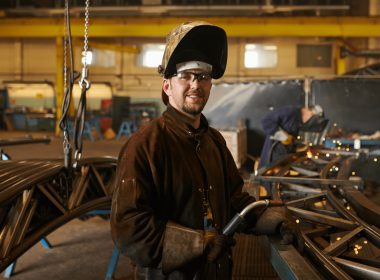
Welders, pipefitters and platers
Repair and maintain tanks, pipework, vessels and other structures used on industrial sites.
Project managers, controllers and designers
Make sure a project is done properly, on time and with the right people and tools, thinking creatively to turn ideas into plans.
Erectors and riggers
Build and dismantle steel structures, and lift, move and position heavy loads safely.
Electrical, mechanical and instrumentation workers
Install, service and repair the equipment and machinery that keep sites running.

Zanib | Technician
“My career started as an ECITB scholar. I now work as an engineering technician. I take pride in keeping vital infrastructure working safely and reliably.”

Adam | Welder
“I got into welding through an apprenticeship after secondary school. I learn new techniques all the time. I’m hands-on and love creating things that last.”

Hannah | Project manager
“I started out studying business and maths at university and then went into a graduate scheme. I like knowing that I’m helping to build things that really matter.”
Where are you on your journey?





Full profile details

What skills do I need?
“Sometimes there’s a stereotype that you have to be really good at maths and engineering is just doing calculations, but it’s so much more than that. I’m a creative person, but I still became an engineer. There are all sorts of skills and roles needed in industry, so don’t feel intimidated.”
Lesley Meredith
Assistant Safety Engineer, AtkinsRéalis
People who work in engineering construction have lots of different
skills.
Here are some of the skills they use every day.
Science, technology, engineering and maths (STEM)
Understanding technology, materials, the environment and using numbers to measure, plan and design.
Creative thinking
Thinking differently to build, fix and design buildings, machinery and structures.
Communication and teamwork
Talking and listening to each other to share ideas and plans.
Attention to detail
Attention to detail is important to make sure work is done safely and on time.
What job could I do?
Whether you want to work with your hands, lead a team, solve complex problems or help build the UK’s clean energy future, there is a role for you in engineering construction – here’s just a few of them!
You could be a…
Craft roles
- Electrical fitter
- Mechanical fitter
- Pipefitter
- Welder
- Fabricator/ plater
- Steel erector
- Plater
- Rigger
- Painter
- Blaster
- Sprayer
Project management and commercial roles
- Project manager
- Project controller
- Estimator
- Planner
- Scheduler
- Cost engineer
Design roles
- Electrical power design technician
- Control and instrumentation design technician
- Mechanical design technician
- Piping design technician
- Structural design technician
Engineering and technical roles
- Electrical engineer
- Instrumentation and control engineer
- Piping engineer
- Structural engineer
- Process engineer
- Systems engineer
- Design engineer (CAD / BIM)
- Engineering technician
- Electrical technician
- Mechanical technician
- Control technician
Health, safety, quality and environmental roles
- Safety, health, environment and quality advisor or manager
- Quality engineer
- Quality inspector
Commissioning, testing and operations roles
- Commissioning engineer
- Commissioning manager
- Test engineer
- Operations engineer
- Maintenance engineer
- Non-destructive testing technician
- Site operations manager

What subjects should I study?
“I focused on science, maths, IT, and English throughout my education. Among these, science and maths were particularly helpful in building the foundational skills needed for my engineering career.”
Kyle Marshall
Instrumentation and Control Engineer, Worley
There’s no single combination. Engineering construction is a broad industry and different roles suit different strengths.
If you’re still at school, subjects like maths, physics, design and technology and chemistry will give you a solid foundation for many roles.
Maths and science not your thing? That’s ok, engineering construction also needs project managers, designers, health and safety professionals and more – so business studies, English, art and IT are all relevant.
The most important thing is that you keep your options open.
Whatever your GCSEs or A-levels look like there’s a route into the industry, whether that’s an ECITB Scholarship, apprenticeship, t-level, degree or a graduate programme. Your results are just the start.

How can I find out more about the industry?
The engineering construction industry
“Attending open days is one of my top tips.”
Valeria Korobka
Project Engineering Manager
The best way to understand engineering construction is to explore it for yourself.
There are lots of simple ways to learn what the industry is really like and which roles might suit you.
You can start by:
- Talking to people already in the industry. Engineers, apprentices and construction professionals are often happy to share what they do.
- Attending careers events, open days or school talks. Ask questions and see real projects.
- Trying work experience, taster days or site visits which are great to get hands‑on insight.
- Exploring online videos, case studies and career stories to see different paths and roles.
- Asking teachers or careers advisors. Speak to them about subjects, apprenticeships and next steps.
Here are some great resources to get you started:
Engineering a Better Future
Visit our Instagram page to hear real stories and keep up to date with the latest opportunities
Visit Engineering a Better Future
STEM.org
Science, technology, engineering and maths learning resources for all ages.
EUK education
Insightful resources, accessible funding, engaging activities and more.
WISE
STEM resources and activities for children to use at home.
James Dyson Foundation
Fun, hands-on engineering challenges for children aged 7-14 to try at home or in the classroom.
Try Engineering
A rich international portal offering high-quality engineering lesson plans and programmes for parents, educators and volunteers aiming to inspire school-age children through creative, curriculum enhancing activities.
Neon
Discover workshops, trips and events from leading providers, alongside inspiring case studies and supportive resources.
Technicians.org
Discover the crucial, exciting roles technicians play across society and the different paths you can take to become one.

Full profile details

What pathways are there into the industry?
“I chose the apprenticeship route for the chance to earn while you learn.”
Cailey Miller, Mechanical Designer Apprentice
Nuvia UK
With a great starting salary, opportunities for global travel and the chance to make a positive impact on the world around you, there are pathways into engineering construction suitable for everyone including:
- V-levels
A new incoming qualification to be introduced from September 2027. They sit alongside A-levels and T-levels as a third, explicitly vocational pathway. They are designed for students who want to explore different sectors before deciding where to specialise.
- T-levels
An alternative to A-levels, apprenticeships and other 16 to 19 courses. Equivalent to 3 A-levels. - Apprenticeships
As an apprentice, you will be employed by a company from day one and will combine practical training with study. - ECITB Scholarships
ECITB Scholarships equip the next generation of engineers with the skills needed for engineering construction projects both for now and the future. The full-time off-the-job engineering programme enables learners to gain industrial skills and knowledge as well as an industry-recognised qualification and CCNSG Safety passport. - Graduate opportunities
As a graduate in engineering construction you’ll experience the satisfaction and challenge of working on real-life projects while receiving a competitive starting salary and the opportunity to broaden your professional qualifications.
Click the button below to find out more about the routes into industry.
Find out more about career pathways

How can I improve the skills I need?
There are lots of ways to improve the skills you might need for a career in engineering construction. Here are our top tips.
Stay curious
Make a habit of asking questions about how things work around you. For example:
- How does a wind turbine produce electricity?
- What keeps our homes powered and connected?
Curiosity is a key skill in engineering construction and it starts with asking “why?” and “how?”.
Get hands‑on and experiment
You don’t need special equipment to start building problem‑solving skills.
Try practical challenges using things like LEGO, model kits, or even recycled materials.
Designing structures, bridges, or simple machines helps develop creativity and logical thinking.
Explore what’s happening locally
Look out for:
- College or training provider open days
- STEM, engineering, or technology clubs
- Skills workshops or taster sessions
These are great ways to see what careers involve in real life and meet people already working or training in the industry.

What courses should I consider?
If you’re thinking about college or university but aren’t sure how engineering or construction fits in, you’re not alone.
Many people working in the industry today discovered engineering construction through their studies, not before them.
Engineering construction needs a wide range of skills – from problem‑solving and design to planning, teamwork and sustainability. There are lots of different courses, at both college and university level, that can lead you into the industry.
Engineering courses
Engineering qualifications are a direct route into engineering construction and are available at both college and university, often in areas such as:
- Mechanical engineering
- Electrical engineering
- Chemical or process engineering
Design, technology and sustainability
Engineering construction needs creative and future‑focused thinkers. Relevant courses could include:
- Design engineering or product design
- Sustainable or environmental engineering
- Digital construction or building information modelling
Craft and trade courses
Craft and trade courses build hands‑on skills for roles that keep engineering construction projects running.
- Electrical
- Mechanical
- Pipefitting
- Plumbing
- Construction
Not sure yet? That’s okay.
You don’t need to have a specific job in mind when choosing a course.
Many college and university routes keep your options open and allow you to discover what you enjoy through projects, placements, apprenticeships and work experience.
College or university can be a way to explore engineering construction, build confidence and skills and decide your next step when you’re ready – but there are alternative routes too, including apprenticeships and ECITB Scholarships.

How do I know if engineering construction is right for me?
“Understanding the different engineering opportunities will help you identify which area aligns with your interests and strengths.”
Kyle Marshall
Instrumentation and Control Engineer, Worley
Engineering construction is a hands‑on career where no two days are the same. The projects you’ll work on will make a lasting difference to communities and the environment.
You might enjoy engineering construction if you:
- Like practical tasks
- Enjoy problem‑solving and finding out how things work
- Are interested in building, designing or improving real structures and systems
- Work well as part of a team
- Want a career with clear progression, training and long‑term opportunities
If you’re motivated, hands‑on and ready to build something meaningful, engineering construction could be the right path for you.
An ECITB Scholarship is one route into industry that could give you a chance to try and learn about lots of different roles. Click the button below to hear from ECITB Scholar Hannah.

Full profile details

Do I need an engineering degree?
No. While engineering degrees are needed for some roles, engineering construction welcomes people from all pathways into the industry.
There are lots of graduate opportunities available for those wishing to join the engineering construction industry whatever your degree.
Your skills and qualifications could be in science, maths, business, project management, environmental studies and beyond. What matters most is a willingness to learn, an interest in how large-scale projects come together and the drive to develop your skills on the job.
Apprenticeships and ECITB Scholarships are valued pathways into the industry too.

What next steps are available after university or college?
Graduates in engineering and construction play a vital role in shaping a more sustainable world for future generations, but what comes next after finishing your studies?
A graduate programme is a structured early‑career opportunity designed to bridge the gap between education and full professional practice. It allows you to gain hands‑on experience, learn from industry experts and apply your knowledge to real‑world projects while continuing to develop professionally. By joining a graduate programme you’ll build specialist skills, explore different areas of the industry, and gain a clear pathway for long‑term career progression. You won’t just start a job, you’ll start a career. A graduate role offers:
- Clear career advancement through structured learning and mentoring
- Support towards professional qualifications and accreditation
- Opportunities to work on high‑impact projects, often on a national or global scale
If you’re ambitious, curious, and ready to make a difference, a graduate programme can be the perfect next step after university or college.

How do I find work experience?
Some undergraduate university courses and college courses offer a year out in industry, providing opportunities to broaden your skillset and establish a network of contacts.
You might already be gaining experience alongside your degree or college course. You can explore opportunities for work experience by checking the careers sections of company websites for opportunities or looking for advertised internships on websites.
Here’s a few useful places to start:
IET
Thinking about bolstering your CV with some experience? It’s definitely a great way to expand your skillset and make you stand out. To learn more about where to start and how to get the most out of the experience, look no further.
This is Engineering
Work experience gives you real life experience in a job role, you’ll get to see what working in an industry is really like. Explore top tips for finding work experience with This is Engineering.
Engineering Development Trust
Working with STEM companies across the UK to provide placement opportunities for school and college leavers.

What are employers looking for?
“Ask questions, lots of them. That’s how you learn from those that have been there and done that.”
Jamie Owen, Electrical Installation Apprentice
Engenda Group
If you’re a graduate interested in engineering construction, employers aren’t expecting you to know everything on day one. What they are looking for is potential – people who are curious, capable and ready to learn.
Employers may look for:
Strong problem‑solving skills
Engineering construction is all about solving real‑world challenges. Employers value graduates who can:
- Think logically and break down complex problems.
- Apply what they’ve learned to practical situations.
- Adapt their thinking when plans or conditions change.
Your degree projects, coursework and group work all help demonstrate these skills.
Willingness to learn and develop
The industry is constantly evolving, with new technologies, materials and methods. Employers look for graduates who:
- Are open to learning on the job.
- Ask questions and seek feedback.
- Show an interest in developing their technical and professional skills.
You don’t need full industry knowledge – just the motivation to build it.
Teamwork and communication
Large engineering and construction projects rely on collaboration.
Employers want graduates who can:
- Work well with others from different backgrounds and disciplines.
- Communicate ideas clearly, both verbally and in writing.
- Listen and contribute positively in team environments.
These skills are just as valuable as technical ability.
Practical mindset
Even in office‑based roles, engineering construction is grounded in the real world.
A practical mindset shows through when graduates:
- Understand how theory applies to real projects.
- Show interest in how things are built, installed or operated.
- Consider safety, quality and efficiency in their thinking.
Initiative and professional attitude
Employers notice graduates who:
- Take responsibility for their work.
- Show reliability and professionalism.
- Are proactive, organised and open to new challenges.
A positive attitude and strong work ethic can be just as important as grades.
Interest in the industry
You don’t need years of experience, but employers value graduates who have:
- Taken time to learn about engineering construction.
- Explored the sector through placements, research or events.
- Shown genuine interest in the projects and challenges involved.
This shows commitment and helps employers see your long‑term potential.
Employers are looking for graduates who are keen to learn, able to think critically, and ready to contribute.
Engineering construction offers varied, impactful careers and for many graduates, the industry values what you can become just as much as what you already know.

Full profile details

How do I find graduate opportunities?
Engineering construction employers recruit graduates into various occupations including mechanical engineers, electrical engineers, project managers and many more.
Graduate jobs and programmes are advertised on the careers sections of company websites, as well as on a number of key job search sites which you can find below.
You can also discuss options with a careers advisor at your university.

What does a graduate career path look like?
A graduate role is the first step in a career that can go in many directions. You’ll grow your skills, expand your responsibilities and begin shaping your own path.
Some graduates choose to specialise in technical disciplines, while others move into project management, leadership or commercial roles. There’s no fixed route, your career will evolve based on your interests, strengths and the opportunities you choose.
Meet Project Engineering Manager and past graduate, Valeria Korobka

What support and development can I expect?
“The biggest benefit to getting on a graduate scheme like I did is that the business recognises you are a graduate and that you need support. They don’t expect you to know everything from day one.”
Lesley Meredith
Assistant Safety Engineer, AtkinsRéalis
From day one, you’ll be supported to develop both professionally and personally guided by experienced colleagues who want to help you succeed.
Support may include mentoring, formal learning, professional accreditation pathways and regular feedback to help you track your progress. As you grow, you’ll be trusted with more responsibility, helping you build a strong foundation for a long‑term career in engineering construction.

What kinds of projects could I work on?
“I have worked on a range of projects, from designing and delivering vessels to clean oil, technology to clean water, and my most recent project has been working to decarbonise a paper mill.”
Valeria Korobka
Project Engineering Manager
As a graduate, you could be involved in some of the UK’s most impactful infrastructure projects. That might include working on a nuclear new build, supporting the delivery of an offshore wind farm, or helping to manage or decommission major energy, water or industrial facilities.
You’ll gain exposure to the full lifecycle of complex projects from planning and design through to construction, commissioning and decommissioning. You’ll see how your work contributes to the systems that power everyday life.
Your skills, your style, your future
Whatever your passion, there’s a place for it in engineering – your skills could be exactly what the future needs.

Eneni pays for things with her fingernails
Eneni pays for things with her fingernails
Visit This is Engineering

Henry believes in the power of teamwork
Henry believes in the power of teamwork
Watch our apprenticeships playlist
Sign up for updates
Your information will be used to subscribe you to our e-newsletter.
For more information, please see our Privacy Notice.